One procedure.
Every detail.
A shared plan.
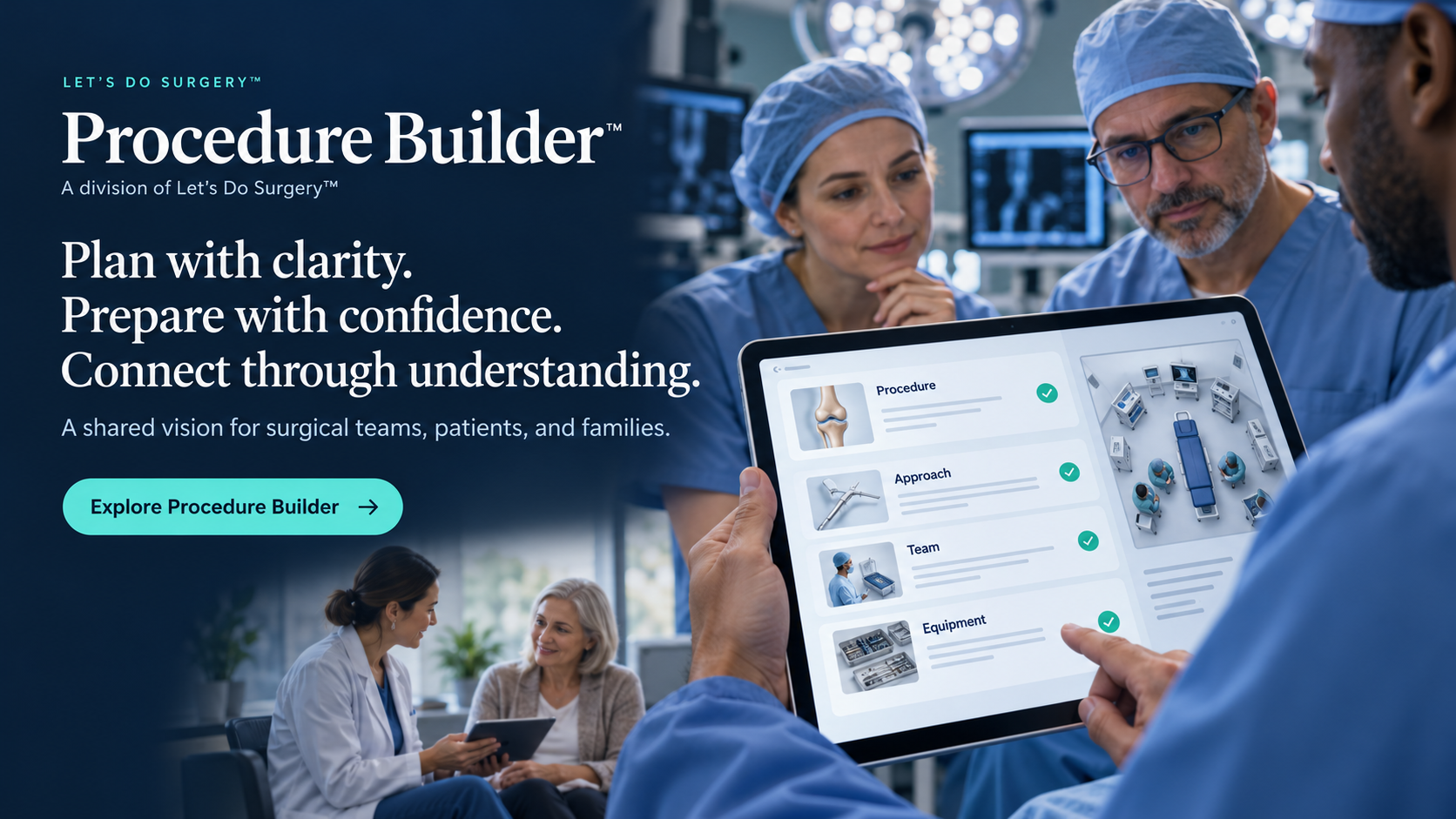
We’re building a clearer way to organize surgical preferences, prepare for procedures, and help patients and families understand the journey ahead.
In development. Explore the vision and help shape what comes next.
Procedure Builder™
Concept previewFrom a procedure name
to a more organized plan.
Start with your procedure.
Select the specialty, procedure, and approach. Add the facility and physician or surgeon preferences that matter to your team.
Bring the details together.
Organize positioning, prep, draping, instruments, equipment, supplies, and procedure notes in one structured plan.
Review with your team.
Use the plan to support preparation and communication, with clinical decisions and final checks remaining with the responsible professionals.
What goes into a procedure?
The planned workspace brings key preparation categories into a consistent, easy-to-follow format.
Patient positioning
Positioning preferences, support equipment, and team preparation notes.
Prep & draping
Preparation areas, draping requirements, and procedure-specific considerations.
Instrumentation
Instrument sets, individual instruments, and surgeon preferences.
Equipment & supplies
Room equipment, packs, disposables, and the items a team needs to review.
Medications
A place to organize medication-related preferences for qualified clinical review.
Implants & devices
Product references, device requirements, and applicable procedure notes.
Built around the people involved.
Surgical teams
For surgeons, anesthesia professionals, nurses, and surgical technologists who need a clearer view of procedure preparation.
Explore the planning vision →Patients & families
Understand procedure terminology, explore educational resources, and prepare questions for your care team.
Explore procedure education →Facilities & industry
Help shape practical workflows and useful product information for the people who prepare for procedures every day.
Discuss collaboration →Cholecystectomy™
One procedure, with planning needs that vary by approach. Explore how a preference card could organize those differences.
Illustrative planning structure only. This is not a complete preference card or clinical protocol.
Open approach
Organize the major instrument tray, retraction preferences, equipment, supplies, and closure notes for review by the team.
Laparoscopic approach
Group the visualization equipment, laparoscopic instruments, access supplies, and surgeon-specific preferences.
Robotic-assisted approach
Bring together platform requirements, compatible instruments, room layout considerations, and team preparation notes.
years of surgical clinical experience behind the vision.
Better preparation starts with understanding the work.
Procedure Builder grew from a practical question: how can the details a surgical team needs become easier to organize, understand, and communicate?
The vision brings professional preparation and patient education into a connected experience, with content appropriate to each audience.
Help shape the future
of procedure preparation.
We’d like to hear from surgical professionals, facilities, patients, families, and industry partners. Tell us what would make this experience useful to you.
Both options open our contact page. Let us know which opportunity interests you.
Let’s Do Surgery
Surgery is one of the biggest decisions a person will ever make.
Every day, thousands of patients hear words they've never heard before:
"You need surgery."
What often comes next is confusion.
What procedure?
Which surgeon?
Which hospital?
What technology?
What are my options?
What should I ask?
Let's Do Surgery™ was created to answer those questions before surgery—not after.