
For surgeons & surgical teams · In development
Procedure Builder AI Assistant
Your preparation.
Connected by intelligence.
A planned smartphone-based assistant to help surgeons and surgical teams organize preference cards, equipment, instruments, and supplies. It could suggest procedure templates and flag missing information for staff review.

Organize the procedure
Bring facility, physician, approach, positioning, instruments, equipment, supplies, and medication-related preferences into one structured workspace.
Start with a template
Explore suggested procedure templates that the team can adapt to the surgeon’s preferences and facility resources.
Review what is missing
Highlight incomplete fields and preparation details that need staff attention before the plan is approved.
Support case-specific preparation
Help teams organize clinician-provided case requirements and requested changes while preserving the master preference card.
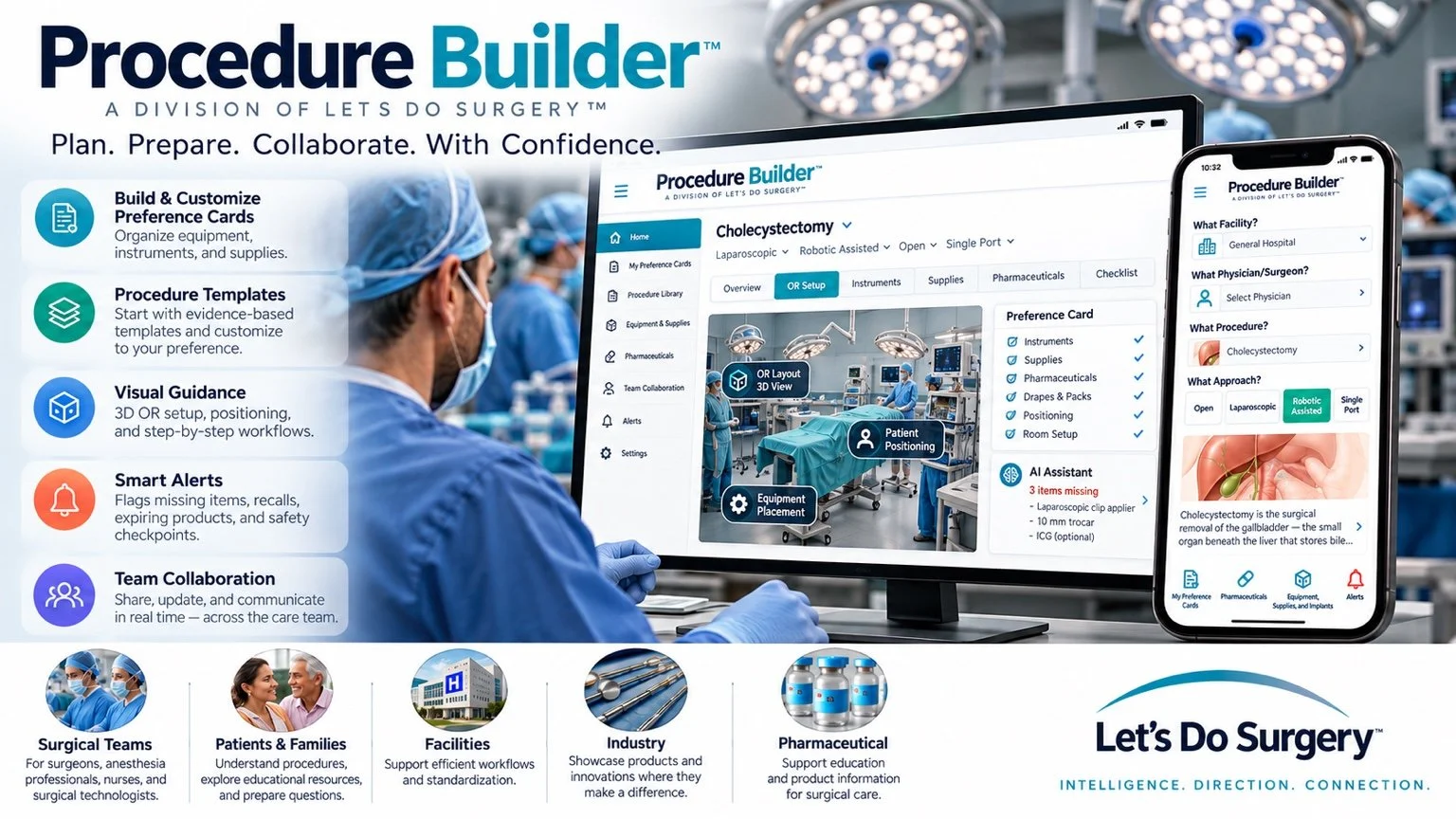
Planned capabilities. AI suggestions would require qualified staff review. Clinical decisions, medication choices, substitutions, and final checks remain with the responsible professionals and facility.
Procedure Builder™ · A Division of Let’s Do Surgery™
Introducing the future of patient-specific surgical intelligence
No two patients are the same.
Why should their surgical preference cards be?
Procedure Builder™ is being designed to transform how healthcare professionals plan, prepare for, and carry out medical and surgical procedures.
At the center of this vision is a Clinical AI Intelligence Engine designed to analyze patient-specific information and transform traditional surgical preference cards into dynamic, personalized procedural plans for professional review.
Development vision · The capabilities described below are planned and subject to clinical validation and applicable regulatory requirements.
01 / The reason for change
Preparation should reflect the individual.
For decades, surgical preference cards have primarily been built around the physician’s preferences and the standard requirements of a procedure. These cards serve an important purpose, but they cannot fully account for one fundamental reality: no two patients are exactly alike.
A 35-year-old patient undergoing a cholecystectomy may have very different clinical requirements from an 85-year-old patient undergoing the same procedure. Even two patients of identical age may present different challenges based on their medical histories, anatomy, previous surgeries, medications, and underlying health conditions.
Procedure Builder™ aims to bring those differences directly into the planning process. Surgical preparations should reflect the needs of the patient, rather than automatically being identical for every case.
02 / The central differentiator
The Clinical AI Intelligence Engine
Rather than simply retrieving a generic preference card, Procedure Builder™ is being designed to analyze relevant patient-specific clinical information, including:
The patient’s clinical profile
- Age, height, weight, and body mass index (BMI)
- Previous surgical procedures and relevant anatomical changes
- Existing medical conditions and comorbidities
- Allergies, medication history, and contraindications
- Cardiovascular, respiratory, renal, and other relevant health factors
The procedure’s requirements
- Available laboratory results and diagnostic imaging
- Procedure complexity and anticipated surgical challenges
- Anesthesia-related considerations
- Individual patient risks
- Special positioning requirements
Using this information, the engine would generate patient-specific procedural planning recommendations for review and approval by the appropriate healthcare professionals.
03 / Beyond the traditional preference card
From a standard checklist to a patient-specific plan.
Illustrative scenario · Robotic-assisted cholecystectomy
Imagine a surgeon scheduling a robotic-assisted cholecystectomy. The surgical team could receive a dynamically generated planning card informed by the patient’s clinical profile, alongside the surgeon’s preferences and procedure requirements.
The system could highlight additional equipment requirements, alternative instruments, special positioning considerations, or other preparation needs based on that patient’s individual characteristics. It could also identify potential concerns requiring clinical review before the patient enters the operating room.
The preference card becomes one component of an intelligent, patient-specific surgical preparation system.
04 / Connecting the plan to the facility
Facility Inventory Intelligence
One of the most significant planned capabilities is the connection between patient-specific clinical planning and the resources available within a healthcare facility. The Clinical AI Intelligence Engine would evaluate recommendations against current inventory information, including:
- Surgical instruments and instrument trays
- Operating room equipment and robotic technologies
- Disposable supplies and procedural packs
- Implants and specialized medical devices
- Pharmaceutical products and relevant medication availability
- Alternative products approved for use within the facility
What is recommended?
Preparation options identified for professional review.
What is available?
Resources recorded in the facility’s inventory and formulary.
What needs attention?
Items that may require additional preparation or procurement.
This connection could help surgical teams recognize potential resource gaps before a procedure begins, with availability and suitability verified by the facility.
05 / Looking beyond today’s inventory
Future Technology and Product Intelligence
The long-term vision extends beyond what a hospital already owns. Procedure Builder™ could help evaluate appropriate medical technologies, devices, instruments, supplies, and pharmaceutical products that may not currently be available at a particular facility.
For example, the system could identify an alternative instrument or technology worth considering based on clinical evidence, procedural requirements, and compatibility with existing equipment. These insights could support purchasing committees, surgical leadership, and healthcare administrators in evaluating future investments.
Procedure Builder™ could help facilities prepare with what they have today and make informed decisions about what they may need tomorrow.
06 / Medication-related preparation
Pharmaceutical Intelligence
A planned pharmaceutical intelligence layer could support licensed healthcare professionals by identifying documented allergies, potential drug interactions, contraindications, formulary availability, and applicable clinical protocols based on relevant patient information.
This would extend Procedure Builder™ beyond instruments and equipment into a more comprehensive procedural preparation environment.
07 / A plan that can evolve
Connected preparation as circumstances change.
As new patient information becomes available or the clinical situation changes, Procedure Builder™ could update its planning recommendations. A change in surgical approach, an unexpected equipment requirement, or a new clinical finding could trigger a review of the procedural plan.
This planned capability could be especially useful in urgent and emergency situations, where surgical teams may have limited time and resources. Its purpose would be to help teams anticipate needs, communicate changes, and prepare more effectively while maintaining established safety protocols and professional oversight.
08 / Our vision
From procedure-based preference cards to patient-specific clinical intelligence.
Procedure Builder™ is being developed around a fundamental shift in surgical preparation.
The traditional preference card asks
What does this surgeon normally use for this procedure?
Procedure Builder™ aims to ask
Given this individual patient’s clinical characteristics, the planned procedure, the surgeon’s preferences, the available facility resources, and current clinical evidence, what preparation options should the healthcare team consider to deliver safe, effective, individualized care?
Our vision goes beyond digitizing a preference card or adding AI to an existing checklist. It is an intelligent clinical planning platform that connects patient information, surgical expertise, facility resources, medical technology, and pharmaceutical intelligence into one coordinated system.
Our defining principle
No two patients are the same.
Their surgical preparation shouldn’t be either.
Procedure Builder™
Patient-Specific Intelligence. Smarter Preparation. Connected Surgical Teams.
A Division of Let’s Do Surgery™
INTELLIGENCE. DIRECTION. CONNECTION.
Help shape what comes next.
Share your perspective or discuss early access, a facility pilot, or collaboration.
Contact our team →