
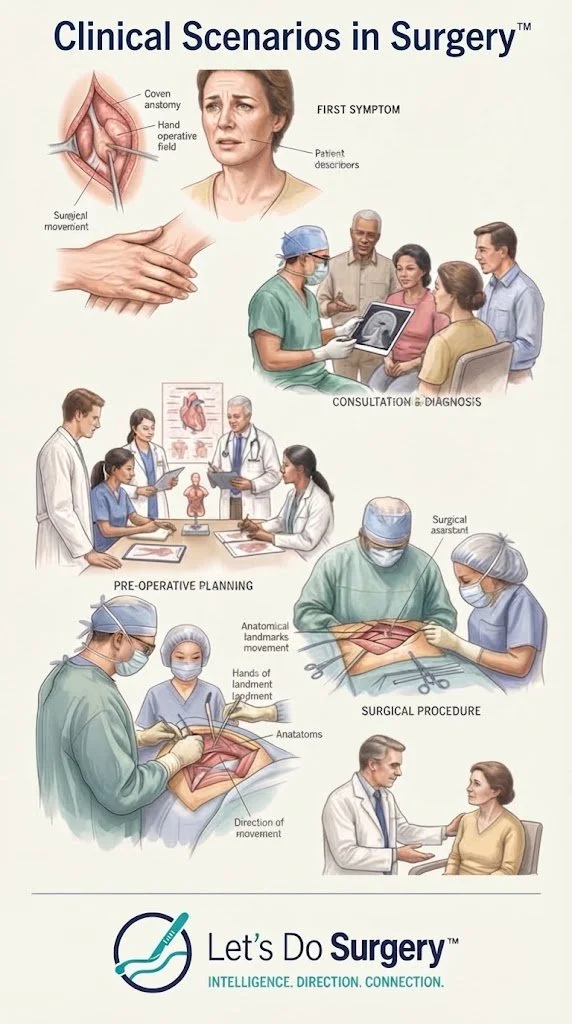
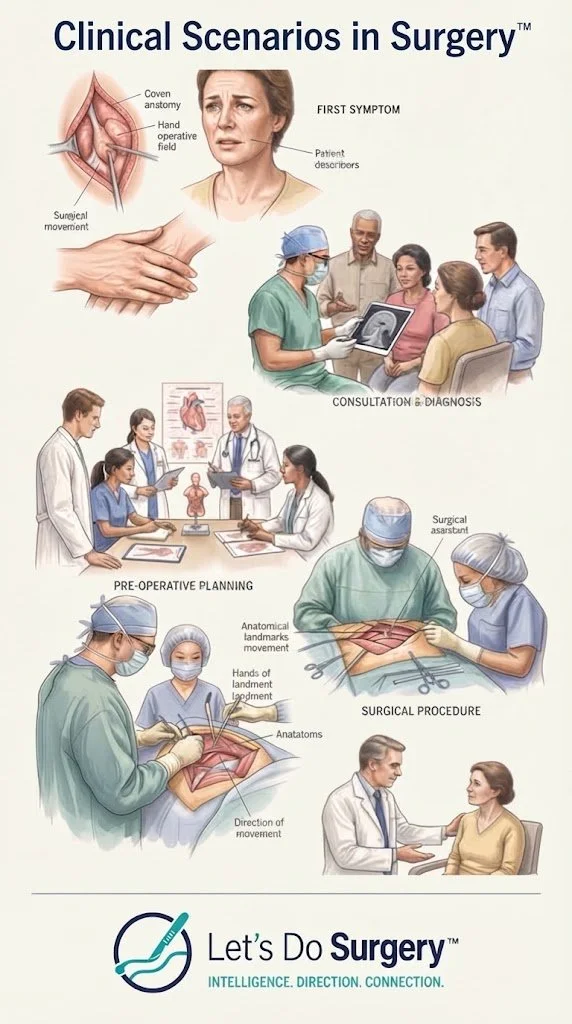
Clinical Scenarios in Surgery™
Clinical Scenarios in Surgery™ is an interactive case-based education system that guides patients, families, students, surgical professionals, and industry partners through the complete journey of a real-world surgical condition—from the first symptom to recovery.
Each scenario transforms a clinical presentation into a structured, visual learning experience.
-
The Patient Presentation introduces the individual, their symptoms, and the circumstances that brought them to medical attention. It establishes the starting point for the entire surgical journey.
Each presentation should include:
Patient profile: Age, sex, relevant occupation, activity level, and living situation
Chief complaint: The patient’s primary concern in their own words
History of present illness: Symptom onset, location, duration, severity, progression, triggers, and relieving factors
Associated symptoms: Additional findings that help define the condition
Medical and surgical history: Existing illnesses, prior operations, anesthesia history, and previous treatments
Medications and allergies: Prescription drugs, supplements, anticoagulants, and known reactions
Family and social history: Relevant hereditary risks, tobacco or alcohol use, nutrition, and available support
Initial assessment: Vital signs, physical examination, and notable clinical findings
Patient concerns: Questions, fears, expectations, and personal treatment goals
Urgency level: Elective, time-sensitive, urgent, or emergent
Example: Acute Cholecystitis
A 35-year-old woman presents with persistent right upper-quadrant abdominal pain that began several hours after eating a fatty meal. The pain radiates toward her right shoulder and back and is accompanied by nausea, vomiting, reduced appetite, and a low-grade fever.
Examination reveals right upper-quadrant tenderness and a positive Murphy sign. Her symptoms and initial findings raise concern for acute gallbladder inflammation, prompting laboratory testing and abdominal ultrasound.
Patient’s central questions:
What is causing the pain?
Is this an emergency?
Will I need surgery?
What treatment options are available?
How long will recovery take?
This scenario is designed for education and shared decision support and does not replace evaluation by a qualified healthcare professional.
-
Patient
A 35-year-old woman presents with persistent right upper-quadrant abdominal pain, nausea, vomiting, and intolerance of fatty foods. The pain may radiate toward her right shoulder or back.
Immediate Assessment
The clinical team first determines whether the patient is stable:
Airway, breathing, and circulation assessed
Vital signs obtained
Pain severity documented
Hydration status evaluated
IV access established
Pregnancy status confirmed
Signs of sepsis, jaundice, or peritonitis assessed
Focused History
Important questions include:
When did the pain begin?
Is it constant or intermittent?
Did it start after eating?
Does it radiate to the shoulder or back?
Are fever, chills, nausea, or vomiting present?
Has she experienced similar episodes?
Is there dark urine, pale stool, or yellowing of the skin?
Does she take anticoagulants or have medication allergies?
Has she had prior abdominal surgery?
Physical Examination
Expected findings may include:
Right upper-quadrant tenderness
Guarding over the gallbladder region
Positive Murphy sign
Low-grade fever
Mild tachycardia
Possible dehydration
The examination should also look for generalized rigidity, rebound tenderness, hypotension, confusion, or jaundice—findings that may indicate a complication or another diagnosis.
Initial Diagnostic Workup
Complete blood count
Comprehensive metabolic panel
AST, ALT, alkaline phosphatase, and bilirubin
Lipase
Urinalysis
Pregnancy test
Right upper-quadrant ultrasound
Additional imaging—such as HIDA scan, MRCP, or CT—may be considered when the diagnosis remains uncertain or a complication is suspected.
Case Findings
Ultrasound demonstrates:
Multiple gallstones
One stone impacted near the gallbladder neck
Gallbladder wall thickness of 5 mm
Mild gallbladder distention
Small amount of pericholecystic fluid
Positive sonographic Murphy sign
Common bile duct measuring 4 mm without dilation
No definite common bile duct stone
Initial Clinical Impression
The presentation and ultrasound findings are strongly consistent with acute calculous cholecystitis caused by an impacted gallstone obstructing the cystic duct or gallbladder neck.
Immediate Management
Nothing by mouth
IV fluids
Pain control
Antiemetic medication
Antibiotics when clinically indicated
Surgical consultation
Assessment for early laparoscopic or robotic cholecystectomy
Safety Escalation
Urgent intervention is required if the patient develops:
Hemodynamic instability
Sepsis
Progressive jaundice
Generalized peritonitis
Suspected gallbladder gangrene or perforation
Ascending cholangitis
Gallstone pancreatitis
Clinical Scenarios in Surgery™
From first assessment to informed surgical decision-making. -
Scenario: 35-year-old female with right upper-quadrant pain and suspected acute cholecystitis.
Assess clinical stability
Airway, breathing, circulation
Vital signs and oxygen saturation
Pain severity and mental status
Look for hypotension, tachycardia, fever, hypoxia, or sepsis
2. Keep the patient NPO
Stop oral food and fluids while diagnostic evaluation and possible surgery are underway.
3. Establish IV access
Begin isotonic IV fluids as clinically indicated
Correct dehydration and electrolyte abnormalities
Obtain blood cultures before antibiotics if sepsis is suspected and this will not delay treatment
4. Control symptoms
Provide appropriate analgesia
Administer antiemetic medication
Reassess pain, abdominal findings, and response to treatment
5. Order the initial workup
CBC
Comprehensive metabolic panel
AST, ALT, alkaline phosphatase, and bilirubin
Lipase
Pregnancy test when applicable
Coagulation studies and lactate for selected or unstable patients
Right-upper-quadrant ultrasound as first-line imaging
6. Begin antimicrobial therapy when acute cholecystitis is suspected
Select antibiotics according to illness severity, allergies, local resistance patterns, renal function, and institutional protocol.
7. Request early surgical evaluation
Consult general surgery promptly. For a stable patient who is an appropriate operative candidate, plan early laparoscopic cholecystectomy during the same hospitalization.
8. Identify urgent escalation findings
Escalate immediately for:
Hemodynamic instability or organ dysfunction
Sepsis or septic shock
Generalized peritonitis
Gallbladder perforation, gangrene, or emphysematous cholecystitis
Jaundice with suspected biliary obstruction
Fever, jaundice, and systemic illness suggesting acute cholangitis
9. Determine whether additional biliary intervention is needed
MRCP, endoscopic ultrasound, intraoperative cholangiography, or ERCP may be considered when choledocholithiasis or cholangitis is suspected. ERCP is not routine for uncomplicated cholecystitis.
Immediate objective: Stabilize the patient, control pain and infection, confirm the diagnosis, detect complications, and move efficiently toward definitive treatment.
-
Our experts develop comprehensive policies, demonstrate adherence through auditing protocols, and mitigate legal exposure across jurisdictions.
Structured Precision, Every Step
Discovery
We initiate each engagement with a focused discovery phase.
Analysis
Collected data is subjected to rigorous quantitative and qualitative analysis.
Strategy Design
Insights inform a tailored strategy that addresses defined goals.
Implementation
Approved strategies transition to implementation under disciplined governance.
Latest Projects
Smart Warehouse Retrofit
We redesigned an aging logistics hub, integrating autonomous robotics and IoT analytics to elevate throughput and reliability.


Initiate a Productive DialogueComplete the form with contextual information regarding your challenges, timelines, and desired outcomes, and our team will respond promptly with an evidence-based recommendation framework.